September Is Vascular Disease Awareness Month: Know the Signs, Protect Your Vascular Health
September is Vascular Disease Awareness Month, an opportunity to learn more about the conditions that…
 Menu
Menu

You’ve been changing your clothes at work because of unexpected bleeding. You’ve skipped a vacation because you can’t stray too far from a bathroom. You’ve started planning your entire social life around your cycle.
If any of this sounds familiar, you are not overreacting — and you are not alone.
Millions of women live with debilitating symptoms for years before learning that there’s a name for what they’re experiencing, and a treatment that doesn’t require major surgery.
Uterine fibroids (also called leiomyomas or myomas) are noncancerous growths that develop in or around the uterus. They range in size from as small as a pea to as large as a grapefruit. Some women have one fibroid; others have several.
The important thing to know is this: fibroids are almost never cancerous, and they are incredibly common. Research suggests that up to 80% of women will develop fibroids by age 50. Yet despite how common they are, they are vastly underdiagnosed — often because women are told their symptoms are “just a bad period” or “normal for your age.”
They’re not normal. And they’re not something you have to just live with.
It’s called uterine fibroids. And the solution may be closer — and simpler — than you think.
Fibroids grow in the wall, surface, or cavity of the uterus. Depending on their size and location, they can:
Not every woman with fibroids experiences symptoms. But for those who do, the impact on quality of life can be enormous.
This is one of the most important sections of this article, because the most common mistake women make is assuming their symptoms are normal.
Here’s what uterine fibroids can feel like:
Heavy or Prolonged Menstrual Bleeding
Soaking through a pad or tampon every hour for several hours in a row, passing large clots, or having periods that last longer than seven days are all signs that something more than a typical cycle is happening. Many women with fibroids become iron-deficient or anemic because of ongoing blood loss — and may experience fatigue, weakness, or shortness of breath as a result.
Pelvic Pain or Pressure
A constant feeling of fullness, heaviness, or dull aching in the lower abdomen is a very common fibroid symptom. It can also feel like pressure — the kind that makes it uncomfortable to sit for long periods or wear tight clothing.
Frequent Urination
Larger fibroids can press against the bladder, causing an urgent or frequent need to urinate, especially at night. Many women are treated for UTIs or overactive bladder for years before a fibroid is discovered.
Painful Intercourse
Fibroids located near the cervix or in certain areas of the uterine wall can make sex painful or uncomfortable.
Back or Leg Pain
Some fibroids press on nerves, causing lower back pain, hip pain, or even pain that radiates down the legs — symptoms that are often attributed to something else entirely.
Bloating or a Swollen-Looking Abdomen
A large fibroid or a cluster of fibroids can cause the abdomen to look visibly enlarged — women often describe it as looking “several months pregnant.”
Difficulty Getting Pregnant
Fibroids in certain locations can interfere with implantation or normal uterine function, contributing to infertility or pregnancy complications in some women.
There are a lot of myths around fibroids that keep women from getting the care they need. Let’s clear a few of them up.
“Heavy periods are just part of being a woman.” No — consistently heavy, disruptive periods are a medical symptom. They are not something you are expected to simply endure.
“Fibroids always need to be removed with surgery.” False. Today there are effective, minimally invasive options that don’t require a single incision or an overnight hospital stay.
“Only older women get fibroids.” Fibroids can develop in women in their 20s and 30s, though they are most common during childbearing years. They often grow more quickly during pregnancy due to hormonal changes.
“If fibroids aren’t cancerous, I don’t need to treat them.” Whether treatment is needed depends on your symptoms and how much they affect your life — not just whether the growths are dangerous. Untreated fibroids can cause significant anemia, organ pressure, and quality-of-life disruption over time.
“Treating fibroids means having a hysterectomy.” This was true for a long time, but it no longer has to be. Uterine Fibroid Embolization (UFE) is a proven, FDA-recognized treatment that does not require removing your uterus.
Uterine Fibroid Embolization — or UFE — is a minimally invasive, outpatient procedure that shrinks fibroids by cutting off their blood supply.
Here’s how it works in plain language:
There are no surgical incisions. Your uterus stays intact. And most patients go home the same day.
UFE may be a good option for you if:
UFE is generally not recommended for women who are pregnant, have certain types of fibroids (like submucosal fibroids in some cases), have active pelvic infection, or are planning future pregnancy — though this is evaluated case-by-case. A consultation with an interventional radiologist will help determine if UFE is right for your specific situation.
Before the Procedure
You’ll have an imaging evaluation (usually an MRI or ultrasound) to map the fibroids and plan the procedure. Your provider will review your health history and answer all your questions.
The Day of the Procedure
UFE is performed in an outpatient setting — meaning you won’t need to stay in a hospital overnight. The procedure typically takes about 60 to 90 minutes. You’ll receive sedation to keep you comfortable throughout.
Recovery
Most women go home the same day and return to light activity within one to two weeks. Some experience cramping and fatigue in the days following the procedure — this is a normal part of the fibroid-shrinking process. Full recovery is typically faster than surgical alternatives.
Results
Fibroids continue to shrink over the weeks and months following UFE. Most women experience a significant reduction in bleeding, pain, and other symptoms. Clinical studies report a patient satisfaction rate of approximately 85–90%.
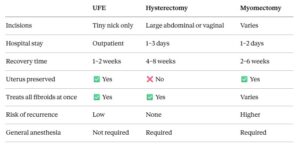
UFE is considered safe and well-established, but like any medical procedure it carries some risks worth discussing with your provider:
Your interventional radiologist will review your imaging and medical history to determine whether UFE is the safest and most effective option for you.
Yes — most insurance plans, including Medicare and Medicaid, cover UFE when it is medically indicated. Because it is an established, evidence-based procedure (not considered experimental), it is typically covered similarly to surgical alternatives.
That said, coverage varies by plan. Before scheduling, it’s always a good idea to:
TRA Endovascular’s staff can help guide you through the insurance verification process.
Don’t wait. If you recognize yourself in any of the symptoms described above, it’s time to have a conversation with a healthcare provider — even if you’ve been told in the past that your symptoms are “normal.”
Consider reaching out if you are:
You deserve answers — and you deserve options.
If you live in Tacoma, Puyallup, Gig Harbor, Olympia, or anywhere in the South Puget Sound region, you don’t need to drive to Seattle for specialized fibroid care.
TRA Endovascular is the only vein and vascular care center in the South Puget Sound offering the full spectrum of care — from imaging and diagnosis to consultation and treatment — all in the same facility. Our board-certified interventional radiologists specialize in UFE and other minimally invasive procedures, and we offer:
We understand that getting care should be simple. Our team is here to walk you through every step — from your first question to your follow-up appointment.
Heavy bleeding. Pelvic pain. Fatigue. Bloating. These are real symptoms — and they have real solutions.
Uterine fibroids affect millions of women, and yet so many spend years suffering in silence because they don’t know they have options. Uterine Fibroid Embolization is a proven, minimally invasive procedure that can dramatically improve your quality of life — without surgery, without a hospital stay, and without removing your uterus.
If you’ve been managing your symptoms alone, now is the time to find out if UFE might be right for you.
You don’t have to just live with this.
Schedule your free virtual consultation with TRA Endovascular today. Our interventional radiology team serves patients throughout Tacoma, Puyallup, Gig Harbor, Olympia, and the greater South Puget Sound area. No referral needed to get started.
📞 Call us at 253-284-0841 🖥️ Request a consultation📍 Conveniently located in Tacoma — no trip to Seattle required
TRA Endovascular is accredited by the American College of Radiology and proudly serves patients across Pierce and Thurston Counties.
Q1: What are the most common symptoms of uterine fibroids?
The most common symptoms of uterine fibroids include heavy or prolonged menstrual bleeding, pelvic pressure or pain, frequent urination, bloating or abdominal swelling, lower back pain, pain during intercourse, and fatigue from anemia caused by blood loss. Some women with fibroids have no symptoms at all, while others experience symptoms severe enough to interfere with daily life.
Q2: What is Uterine Fibroid Embolization (UFE)?
Uterine Fibroid Embolization (UFE) is a minimally invasive, outpatient procedure that treats uterine fibroids without surgery. A physician called an interventional radiologist guides a thin tube through the blood vessels to the arteries supplying the fibroids, then blocks those arteries with tiny particles. Without a blood supply, the fibroids shrink over time and symptoms improve. UFE preserves the uterus and does not require general anesthesia or a hospital stay.
Q3: Is UFE a safe alternative to hysterectomy?
Yes. UFE is an established, FDA-recognized procedure with a strong safety record. Studies consistently report patient satisfaction rates of 85–90%. Compared to hysterectomy, UFE involves no surgical incision, requires no general anesthesia, has a significantly shorter recovery time (1–2 weeks versus 4–8 weeks), and preserves the uterus. It is considered safe for most women with symptomatic fibroids.
Q4: Will UFE affect my ability to get pregnant?
UFE is generally not recommended for women who are planning future pregnancies, as its effect on fertility is still being studied. Women who have completed childbearing or are not planning pregnancy are typically the best candidates. If pregnancy is a consideration for you, discuss all available options — including myomectomy (surgical fibroid removal) — with your provider before deciding on treatment.
Q5: How long does recovery take after UFE?
Most women recover from UFE within one to two weeks and are able to return to light daily activities. Some experience cramping, fatigue, or mild flu-like symptoms in the first few days — this is a normal response as the fibroids begin to shrink. Full recovery is typically much faster than after a hysterectomy or myomectomy, which can require four to eight weeks.
Q6: Does insurance cover Uterine Fibroid Embolization?
Most insurance plans, including Medicare and Medicaid, cover UFE when it is medically necessary. Because UFE is a well-established, evidence-based procedure, it is typically covered similarly to surgical treatments for fibroids. Coverage details vary by plan, so it is important to verify your specific benefits and ask about pre-authorization requirements before scheduling.
Q7: How do I know if I have uterine fibroids?
Uterine fibroids are typically diagnosed through a pelvic ultrasound or MRI. If you are experiencing heavy periods, pelvic pain, frequent urination, bloating, or other symptoms described in this article, speak with your primary care provider or OB-GYN about being evaluated. You can also schedule a free virtual consultation with an interventional radiologist at TRA Endovascular — no referral is needed.
Q8: Where can I get UFE treatment near Tacoma, Washington?
TRA Endovascular, located in Tacoma, WA, offers Uterine Fibroid Embolization for patients throughout the South Puget Sound region — including Puyallup, Gig Harbor, Olympia, and surrounding communities. TRA Endovascular provides on-site imaging, free virtual screenings, and outpatient UFE procedures — all without requiring patients to travel to a Seattle hospital. Call 253-284-0841 or visit traendovascular.com to schedule.